11 hr 30 min
Val d'Orcia Day Trip from Florence with Wine Tasting
Escape to Tuscany's UNESCO countryside for wine tastings and medieval hilltop towns.
Reserve
Hand-picked by our editors — only the best 5 experiences from 140 reviewed.
Verified partners for every tour, free cancellation where available, and instant confirmation on every booking.
11 hr 30 min
Escape to Tuscany's UNESCO countryside for wine tastings and medieval hilltop towns.
Reserve
12 hr
Full-day coach trip from Florence through the Val d'Orcia with two wine tastings and three medieval hilltowns.
Reserve
10 hr 30 min
Full-day Tuscany escape from Florence: Brunello tastings, a Pienza lunch, and Montepulciano's cellars.
ReservePrices from verified partners. Availability updates in real time at checkout. Free cancellation policies apply where shown.
The landmarks, rooms, and views travelers on this tour remember — all visible on a single visit.
Rows of vines producing the region's signature grapes for local val d orcia wine tasting.
Traditional wooden casks where wines age during the production process for a val d orcia wine tasting tour.
Landscaped outdoor spaces surrounding the winery grounds.
They complement each other; most visitors who do both find the rolling vistas of the south more serene compared to the historic estates of the north. Planning a val d'orcia wine tasting tour allows for a distinct immersion into the high-altitude terroir of the Sienese hills.
| Feature | Top pick Val d'Orcia | Chianti Classico |
|---|---|---|
Primary Grape |
Sangiovese Grosso | Sangiovese |
Landscape |
Open rolling hills and cypress trees | Forested ridges and vineyards |
Key Towns |
Pienza and Montalcino | Greve and Castellina |
Atmosphere |
Quiet and expansive | Traditional and dense |
Travel Distance from Siena |
45–60 minutes | 30–45 minutes |
| See tickets → |
Verdict: Choose val d'orcia wine tasting tours for dramatic horizon views, or select Chianti Classico if you prefer deep woods and dense winemaking heritage for your val d'orcia wine tasting tickets.
Choose your ticket, select your date, and reserve in under two minutes. Secure checkout handled by our verified partner.
Instant confirmation by email, with a mobile voucher you can save offline. No printing, no queuing at a collection desk.
Arrive at the entrance, show your voucher on your phone, and walk in. Most tickets include priority or skip-the-line access.
Practical details for your visit straight from our verified partners — hours, access, rules, and how to get there.
Varies by selection
Follow specific booking confirmation address
The most reliable way to navigate the region and reach various estates.
Available from nearby towns for short transfers between wineries.
Casual attire is appropriate for a val d orcia wine tasting tour. Wear comfortable shoes for walking through vineyard rows or cellar floors.
Small personal bags are generally permitted during a val d orcia wine tasting. Large luggage may be restricted due to limited space in tasting rooms.
Photography is usually welcome during a val d orcia wine tasting experience. Please respect the privacy of other guests and staff in production areas.
Vineyard estates vary in accessibility for visitors seeking val d orcia wine tasting tickets. Contact individual wineries in advance to confirm wheelchair access.
Many venues allow children to accompany parents during a val d orcia wine tasting. Note that minors cannot participate in alcohol sampling.
Snacks are often provided during a val d orcia wine tasting tour, typically including local pecorino cheese or bruschetta. Outside food is generally discouraged.
Best time to go, insider tips, nearby landmarks, and the cancellation fine print — flip through to skim what matters to you.
How crowds, weather, and events shift across the year.
Mild temperatures ideal for walking through the fields and enjoying the landscape.
Warm weather perfect for enjoying a val d orcia wine tasting tour in the late afternoon.
Harvest season offers a dynamic look at the winemaking process during late summer.
Quieter period suitable for indoor cellar visits and intimate val d orcia wine tasting tickets.
Small details that turn a good visit into a great one.
Wineries typically require advance appointments for tastings during the summer season.
Check specific opening days for val d orcia wine tasting tours before finalizing your itinerary.
Car rental is highly recommended to reach remote estates comfortably.
Group your val d orcia wine tasting tour with visits to Pienza or Montepulciano.
Carry water while navigating between rural estates in the summer heat.
Non-bookable sights within a short walk — free to visit, easy to pair.
A scenic chapel set amidst the rolling hills of the region.
Protected natural area offering expansive views of the Tuscan landscape.
Renaissance palace located in the heart of Pienza.
Flexible, no hidden fees.
Individual winery policies vary regarding the 0 EUR entrance fee base. Check specific val d orcia wine tasting tour terms for deposit refundability.
Hand-picked options within walking distance — pick a district for vibe, or a specific hotel for convenience.
Centrally located in the heart of the region.
Upscale farmhouses offering panoramic valley views.
Broad selection of hotels near transport hubs.
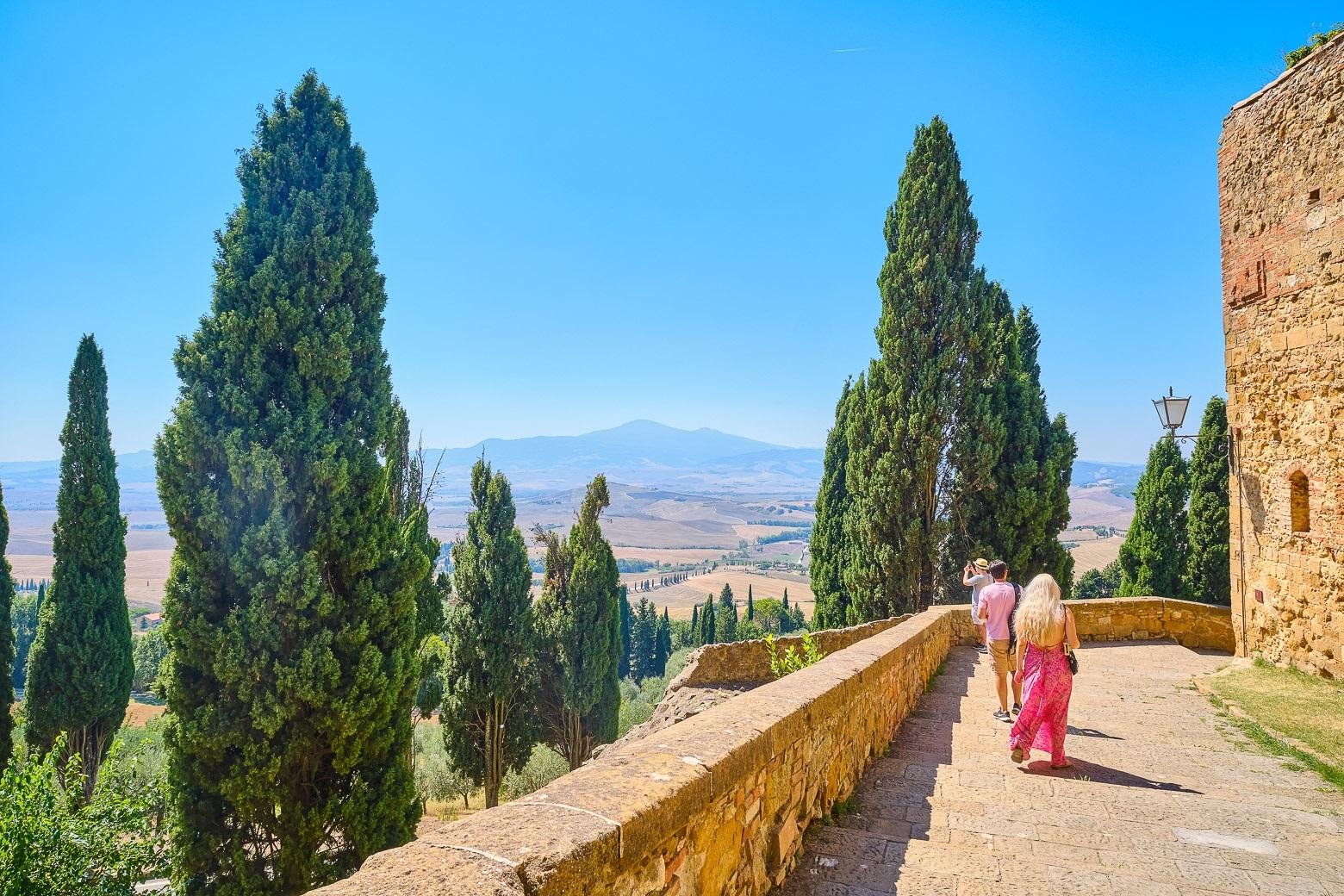
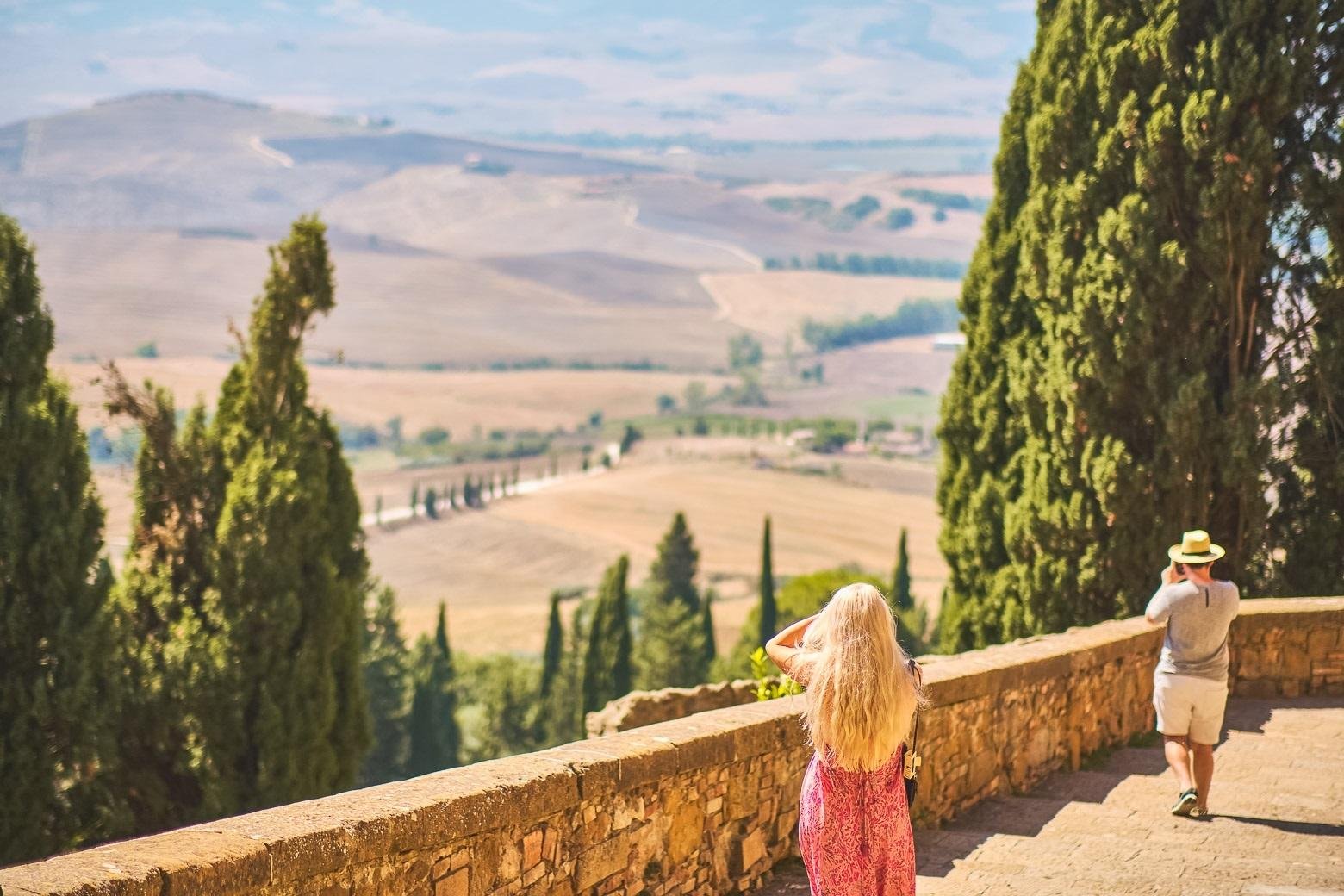
UNESCO inscribed the Val d'Orcia in 2004 as a cultural landscape: farmland listed not for any single monument but as a deliberate work of art. The valley was reshaped between the fourteenth and fifteenth centuries, when Sienese landowners divided the chalky crete into grain estates and lined the farm drives with cypress as windbreaks. Ambrogio Lorenzetti had already painted this arrangement of fields and fortified hill towns in Siena's Palazzo Pubblico around 1338, in the fresco cycle on good government. The scenery visitors photograph today is, in effect, a medieval agricultural plan that was never overwritten. Wine followed the same slow logic. Val d'Orcia wine tasting tours converge on two appellations that Italy raised in 1980 into its first rank of DOCG wines: Brunello di Montalcino and Vino Nobile di Montepulciano. Brunello is made from Sangiovese Grosso alone and cannot be released until five years after the harvest, six for a riserva. Clemente Santi showed a Montalcino red at exhibition in the 1860s, and his descendants at Biondi-Santi are generally credited with fixing the style. Vino Nobile, aged a minimum of two years, was called the king of all wines by the physician-poet Francesco Redi in 1685. Soil does much of the arguing. Montalcino's slopes fall from roughly 120 to 650 metres, mixing galestro schist near the hilltop with heavier marine clays toward Sant'Angelo in Colle, so two bottles of the same vintage can taste a decade apart. Montepulciano works sandier Pliocene deposits, part of the reason Vino Nobile arrives softer and earlier. Orcia DOC, created in 1997 in the ground between them, remains the smallest and least exported of the three, and a degustazione there often takes place at the kitchen table of the grower. Architecture punctuates the vineyards. Pienza was rebuilt for Pope Pius II between 1459 and 1462 by Bernardo Rossellino, who compressed a cathedral, a papal palace and a town hall onto one trapezoidal square. The Romanesque abbey of Sant'Antimo stands alone in an olive valley below Montalcino, its alabaster capitals warming as the light moves. Montalcino's fortress dates from 1361; the Tempio di San Biagio, begun below Montepulciano by Antonio da Sangallo the Elder in 1518, was built in travertine the colour of bone. The valley matters now because it stayed small. Montalcino counts around 250 producers across some 2,000 hectares of Brunello vineyard, many of them family holdings of three or four hectares, while Montepulciano's cellars burrow beneath the medieval main street on Etruscan foundations. There is no gate and no entrance fee for the landscape itself; Val d'Orcia is a region rather than a venue, and each estate sets its own terms, which is why almost all of them work by appointment. A Val d'Orcia wine tasting tour is therefore a key rather than a queue, and a Tuscan wine country tour linking Pienza's pecorino cellars with the Sangiovese terraces reads as one document rather than a list of stops.
"The scenery visitors photograph today is, in effect, a medieval agricultural plan that was never overwritten."
A step-by-step walkthrough of the visit — what you'll see, how long each stage takes, and the details that matter.
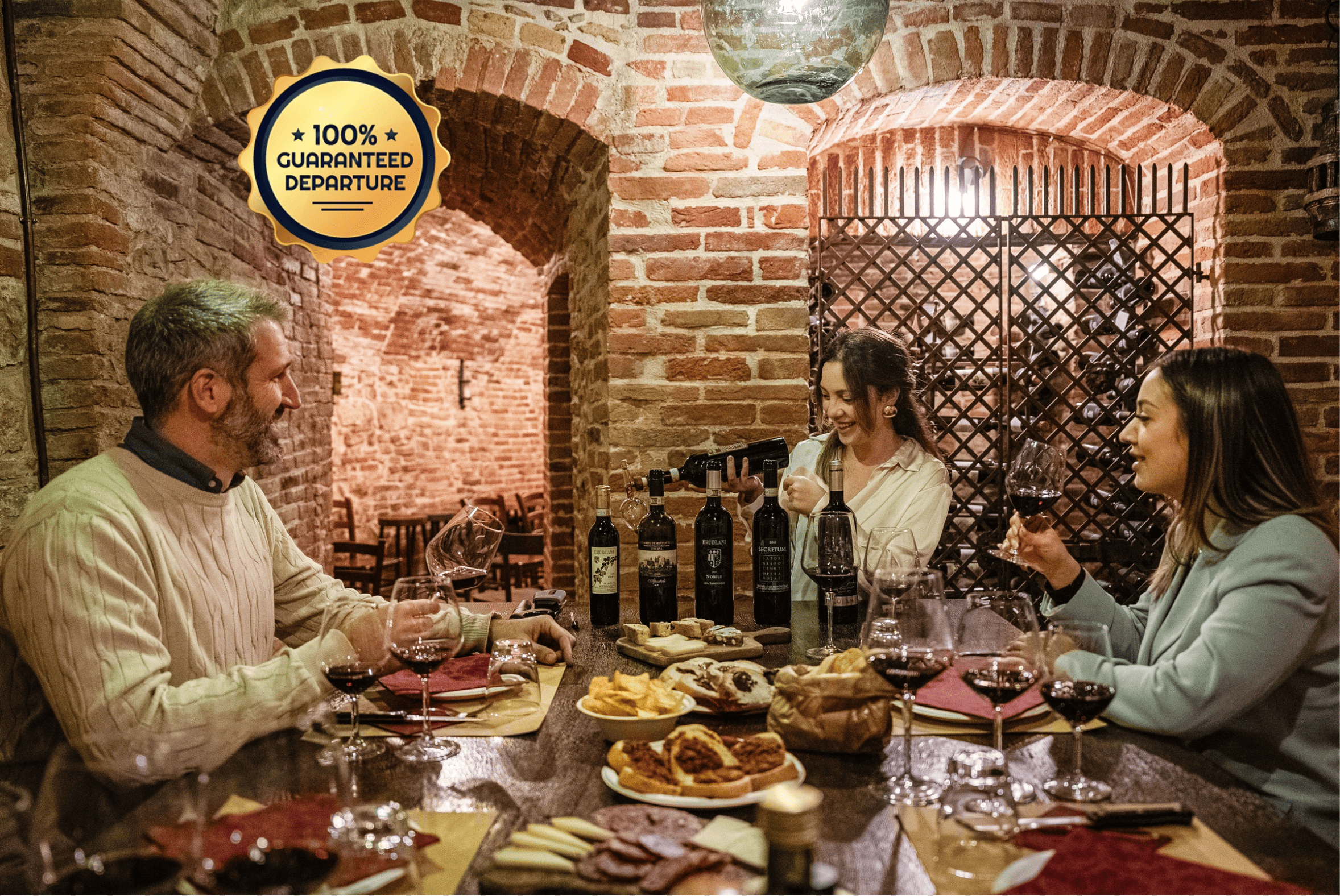
You leave the city early and watch Tuscany simplify. Departures from Florence gather near Santa Maria Novella; the Siena itineraries start closer to the vines and reach the first cellar sooner. After Buonconvento the road empties, and the windows fill with clay ridges, cypress rows, then the vineyard terraces of Montalcino. You climb to the fortress first, walk a stretch of the 1361 ramparts, and look south toward Monte Amiata. Then you go underground. Your val d'Orcia wine tasting tickets name a meeting point and an estate, and a cellar hand pulls the door on a room cooler than the courtyard, where Slavonian oak botti stand in rows and chalk marks record the vintage. You swirl, hold the glass to the lamp, and notice the brick edge five years of ageing gives Brunello. Lunch on the Siena itinerary lands here: bread without salt, pecorino, hand-cut pici. Nobody hurries you through the last pour. Pienza comes next. You cross Rossellino's square in ten minutes, press a hand to the warm travertine of the Duomo, and buy pecorino wrapped in walnut leaves on Corso il Rossellino. The valley falls away from the town wall in bands. Montepulciano closes the day. You walk uphill to the Piazza Grande, then down a staircase into a cellar cut through tufa, and taste Vino Nobile beside barrels stacked three high. Most itineraries keep you inside the 10:00–17:00 window before turning north; you doze on the return, glass rings drying on the paper placemat.
Entrance fee: 0 EUR (Val d'Orcia is a region, not a single venue; individual winery fees vary.)
Yes, booking val d orcia wine tasting tickets in advance is standard for most estates.
The best arrival window is 10:00–17:00 for your val d orcia wine tasting.
Wineries are currently closed for walk-ins, as they require advance appointments for val d orcia wine tasting visits.
Photography is generally permitted during a val d orcia wine tasting experience.
Yes, families are welcome, though minors may not participate in a val d orcia wine tasting.
Yes, wineries typically require advance appointments for all val d orcia wine tasting visits.
Accessibility varies by individual estate for those attending a val d orcia wine tasting tour.
Local products like pecorino or bread are often included with a val d orcia wine tasting.